
Sustainability begins before the menu: how Provenance cooks with limits
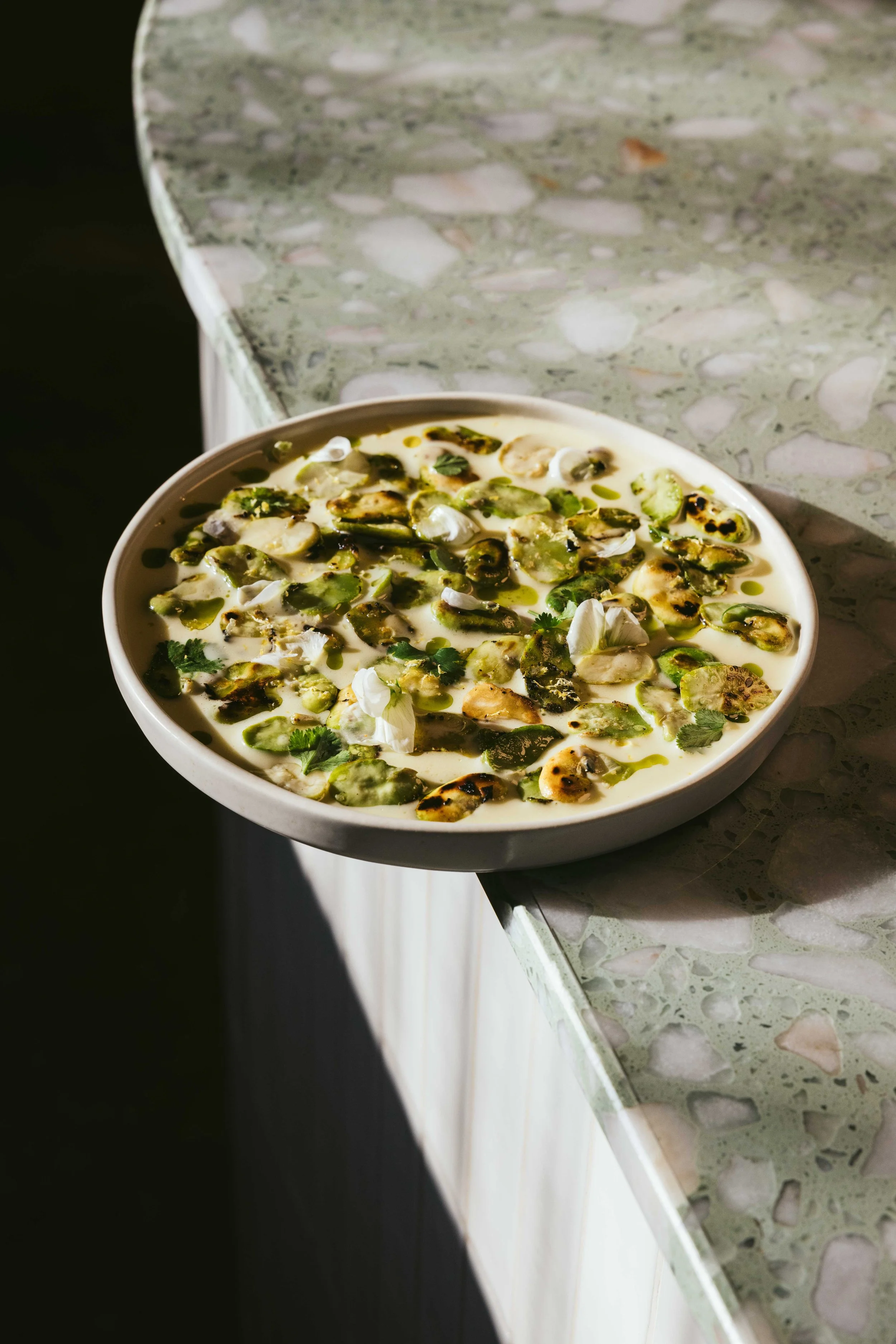
Some restaurants start with the dish. Others start with the concept. The Provenance restaurant in Montemor-o-Novo started with boundaries.
Territorial boundaries. Seasonal boundaries. Boundaries of what makes sense to cook in a specific place, in Alentejo, today. Cooking with boundaries is not a creative limitation. It is exactly the opposite. It is what forces you to make better decisions.
Cooking locally does not mean buying "locally."
The word "local" has become convenient. Too convenient. Buying a product produced somewhere in Alentejo is not the same as cooking with the territory. Cooking with the territory means accepting that not everything is always available, that availability varies, and that industrial regularity does not exist.
At Provenance, this translates into a menu that changes, not because of trends, but out of necessity. There are weeks when certain ingredients are simply unavailable. There are dishes that disappear for months. There are decisions that are not ideal for marketing, but are consistent with how the food arrives here.
Mostly plant-based is not an absence. It is a choice.
Much of Provenance's cuisine centers on vegetables, legumes, grains, and herbs. Not because meat or fish are forbidden, but because historically they have never been the center of everyday eating in this region.
Meat appears when it makes sense. Fish appears from time to time. And when they appear, they are treated as important ingredients—not as automatic fillers for the plate. Cooking this way requires more technique, more attention, and more time. But it restores complexity to simple things.
Zero waste isn't about aesthetics, it's about organization
Provenance's zero waste policy is not based on slogans. It is based on practical decisions.
menus designed to reuse cuts and leftovers
preparations that change throughout the week
ingredients used whole whenever possible
There is no romanticization of waste avoidance. There is daily work, planning, and a clear acceptance: absolute zero waste does not exist. What does exist is constant and conscious reduction.
Getting to know your suppliers changes your kitchen
At Provenance, suppliers are not just names on a list. They are people known by name, by how they produce, and by the limitations they also face.
This creates a different relationship with the kitchen. There is no "demand" for products. You work with what you have. Sometimes the size changes. Sometimes the quantity is wrong. Sometimes the ingredient disappears. And the menu adapts. This adaptation is not a sign of weakness. It is a sign of maturity.
Honey instead of sugar, because that's also a decision
At Provenance, we don't use refined sugar. We use honey—mostly from our own bees. It's not a symbolic gesture. It's a practical choice that changes recipes, balances, and cooking methods. It forces us to think less about immediate sweetness and more about layers of flavor. Like many other decisions in the kitchen, it's not perfect. But it's consistent.
Coffee isn't just coffee
The coffee served at Provenance is not treated as an inevitable detail at the end of the meal. We work with Sical organic coffee and specialty coffee from Baobá, because coffee also has origin, impact, and quality. And because it makes no sense to talk about the product and then serve something undifferentiated. Here, even the coffee tells a short—but clear—story.
Cooking with real miles
Whenever possible, Provenance works with the logic of the kilometers traveled by ingredients until they reach the kitchen. Not everything comes from nearby. And when it doesn't, this is acknowledged. Wheat, for example, is rarely local.
Some ingredients simply do not exist here. Sustainability is not about pretending otherwise. It is about knowing exactly where everything comes from and consciously deciding when it makes sense to bring it from further away.
The menu as a consequence, not as a starting point
At Provenance, the menu is not a manifesto. It is a consequence. A consequence of how the region produces. Of how suppliers work. Of how the team cooks. And of how Gandum positions itself as an independent project. In the evening, the experience can be more gastronomic.
At lunchtime, it can be simple and affordable, even for those coming from Montemor-o-Novo or passing through Alentejo. This flexibility does not dilute its identity. It makes it livable.
Sustainability without purity
Provenance's cuisine does not aim to be exemplary in a moral sense. There are no dogmas, no absolute rules, no set recipes.
There are daily choices. Some are easier. Others are more difficult. Sustainability, here, is not a label applied to the menu. It is an ongoing process, subject to review, improvement, and constant learning. And perhaps that is what most distinguishes this kitchen: not the promise of perfection, but the refusal to cook without thinking.