
Building a hotel on land: why structural rammed earth changes everything
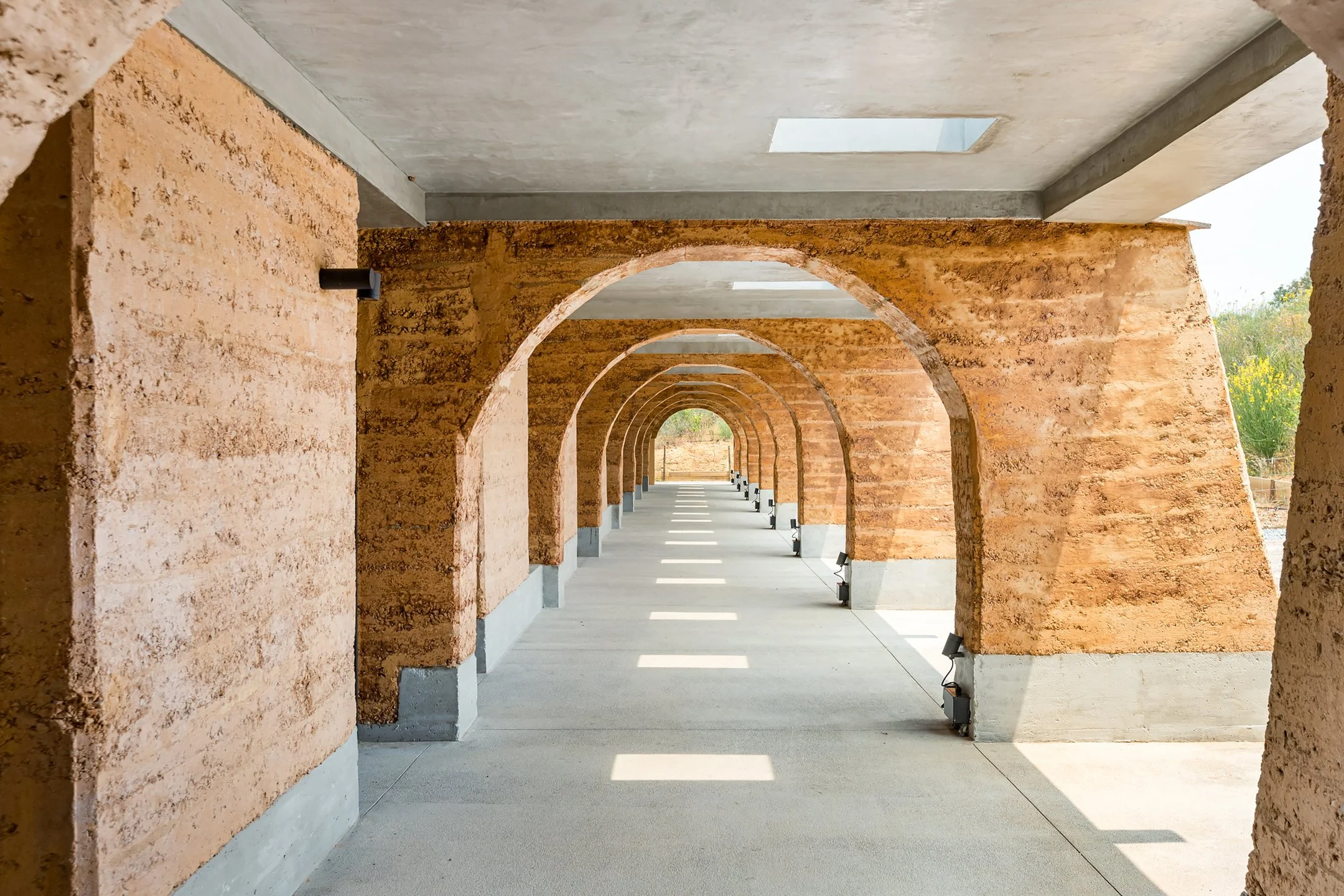
Most hotels start with a form. Some start with a concept. Very few start with the material.
Gandum started with the land.
Not as an aesthetic choice, not out of nostalgia, and certainly not as a branding decision—but as a structural decision. Opting for structural rammed earth defined everything that came after: the architecture, energy performance, comfort, pace of construction, and ultimately, how the hotel operates on a daily basis.
Today, Gandum is one of the largest contemporary buildings in the world made of structural rammed earth used for hospitality. Not as an experiment or prototype, but as a real place—inhabited, used, cleaned, heated, cooled, and lived in.
The earth is not a finish.
It is structure.
In most contemporary construction, materials are layered. First the structure, then the finishes. Concrete provides support; materials come later to add appearance, texture, or comfort.
Earthwork functions differently. Here, the wall is the structure. That changes everything.
The walls of Gandum are not decorative coverings. They are load-bearing, solid, continuous elements that define space, temperature, acoustics, and atmosphere in a single gesture. There is no separation between what you see and what works.
This simplicity is deceptive. Building with rammed earth requires precision, engineering, and a deep understanding of the material. There is no drywall to hide mistakes. There are no machines to correct what was poorly done. The building must function as it was built.
thermal paste instead of mechanical correction
One of the biggest misconceptions about sustainable buildings is the idea that sustainability comes from adding technology. More systems. More control. More equipment. Earthen walls do the opposite.
The mass of the walls creates thermal inertia. Heat enters slowly. Cold leaves slowly. Temperature variations are smoothed out before they are even felt inside.
At Gandum, this translates into:
cool interiors in summer, without aggressive cooling
spaces that retain heat in winter
less dependence on constant mechanical systems
The technology exists—and it is efficient—but it no longer serves to compensate for basic errors. It serves to support a building that already functions on its own. Here, sustainability is designed into the wall, not added later.
, a building that ages rather than deteriorates
Most hotels are built to look good on opening day. Very few are designed to age well. Land ages differently. It doesn't peel like paint or degrade like composite materials. It gains patina. It records time. Small imperfections don't diminish the building—they make it more human.
At Gandum, durability was a central concern. This is not a building designed to be reinvented every decade to follow trends. It was designed to remain relevant without changing, precisely because it is honest about what it is made of.
Thinking this way is, in itself, a radically sustainable decision.
Build slower,
but build once
Building with rammed earth is slow. It requires skilled labor, patience, and a pace that does not lend itself well to accelerated schedules. Choosing it meant accepting: longer construction time, greater initial complexity, fewer shortcuts. But it also meant avoiding: synthetic layers, disposable finishes, and future structural corrections.
In an industry accustomed to speed and repetition, building slowly is a clear position—but above all, it is a long-term risk reduction strategy.
Comfort you can feel before you even realiz
Most guests arrive at Gandum without knowing that they are sleeping between earthen walls. Many do not even notice it right away. What they feel is something else, something more difficult to name: silence, stable temperature, calm, better rest. These are not planned experiences. They are architectural consequences.
The body reacts to space before the mind interprets it. Earth does not announce itself; it regulates, absorbs, stabilizes. Comfort appears discreetly, without explanation.
Why this matters
beyond Gandum
Much of the discourse on sustainability in the hotel industry focuses on operations: energy, water, waste. All of this is important. But it happens after the building exists. Structural decisions come first.
By choosing earth as its structure, Gandum reduced the need for future correction, optimization, and compensation. This is sustainability at its source, not on the surface. In a context where sustainability is often performative, this distinction is essential.
Earth as a contemporary material
Earthen walls are often seen as a return to the past. In reality, at Gandum, it is a fully contemporary construction system, engineered to meet current requirements for safety, comfort, and durability.
There is nothing rustic about it.
Nothing symbolic.
Nothing decorative.
Just one material fulfilling several functions at the same time—structural, thermal, acoustic, and spatial.
, but build better
Calling Gandum sustainable just because it is made from earth would be simplistic. The essential thing is not the material itself, but the logic that led to its choice. Build less. Add fewer layers. Rely more on physics than on subsequent correction. Think in terms of decades, not eras. Structural rammed earth requires this.
And once that decision is made, everything else—energy, food, furniture, working conditions—begins to fall into place naturally. Not because sustainability is a goal, but because consistency is no longer optional.