
Comfort without plastic, polyester, or compromise
For a long time, comfort meant adding layers. More foam. More synthetics. More quick fixes to correct problems created earlier.
At Gandum, comfort was conceived in a different way. Not as excess, but as consistency. This led to a decision that is unusual in the hotel industry: to avoid disposable, synthetic, or short-lived materials whenever possible—even when this means more work, higher costs, or a longer search.
Comfort begins before contact
Much of the comfort is felt before touching anything. It is felt in the temperature of the space. In the way sound dissipates. In the absence of unnecessary stimuli.
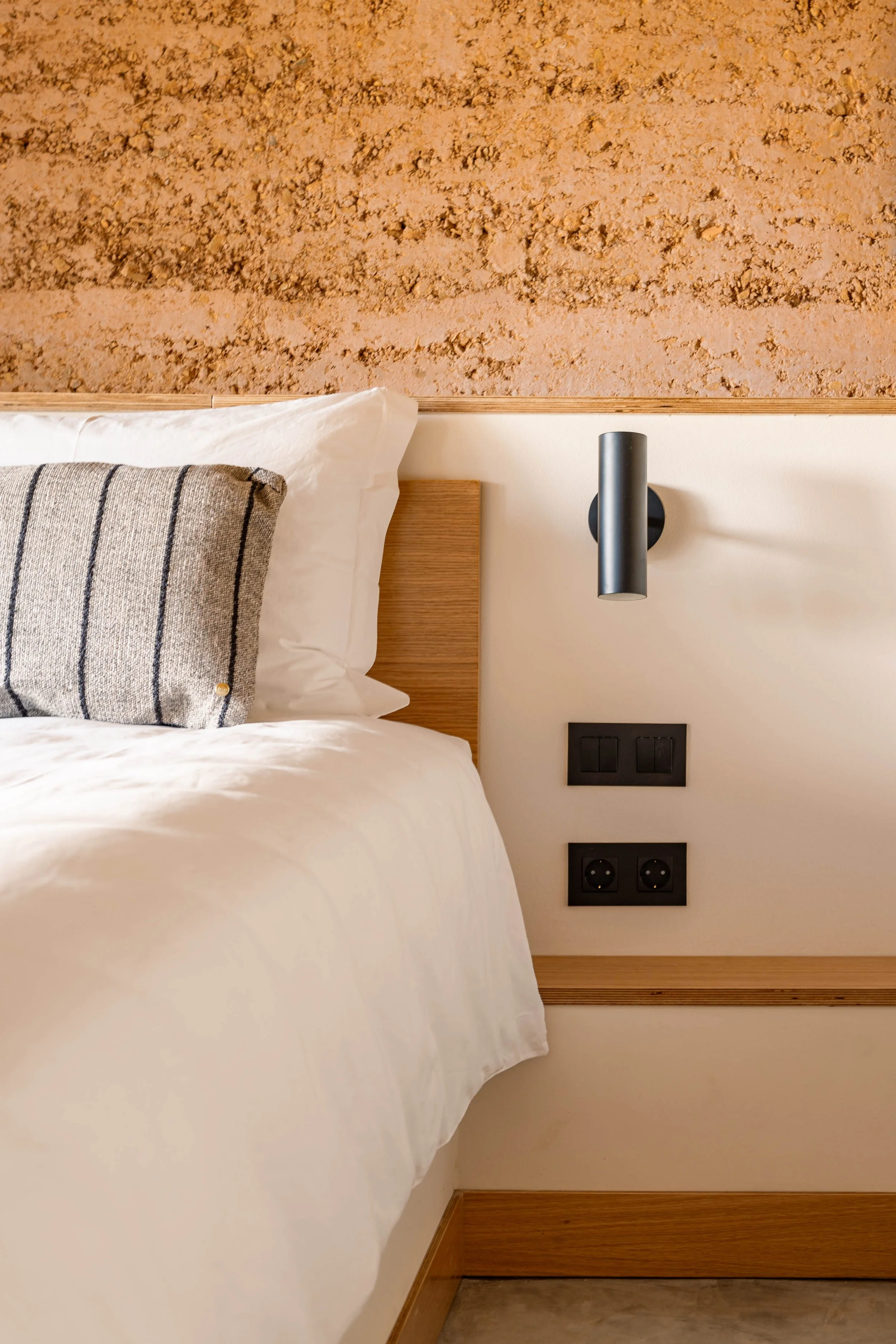
Structural rammed earth architecture creates a foundation where thermal and acoustic comfort does not depend on artificial materials. This drastically reduces the need for compensation with technical fabrics, complex foams, or disposable solutions.
Space does the work first.
Sleeping better does not depend solely on the mattress
The rooms at Gandum were not designed as isolated units, but as part of a system. The mattresses are organic, chosen for their durability and real comfort, not for trends. The bedding is natural, breathable, designed to withstand washing and years of use without losing quality.
Nothing here was chosen to "feel comfortable" at first touch. It was chosen to remain comfortable after hundreds of nights.
Materials that age gracefully
Plastic and polyester solve problems quickly. They also age poorly. At Gandum, the criterion was simple: materials that do not age are not of interest. Solid wood, natural fabrics, resistant fibers, finishes that gain patina instead of degrading.
The goal was not to create immaculate rooms, but livable rooms that maintain quality without requiring constant replacement. Durability here is a quiet form of sustainability.
Amenities that don't seem like amenities
The amenities in the rooms follow the same logic: simple, natural, functional. No excessive packaging. No aggressive fragrances. No artificial promises. These are products chosen to be used without thinking about them—and that, in a hotel, is perhaps the highest praise possible.
Design without fetishism
Gandum's furniture is mostly made in Portugal, with Nordic influences, simple lines, and a focus on function. There are no pieces chosen to impress. There are no objects that compete with the space. The design is there to serve everyday use: sitting, resting, working, relaxing. Nothing more. When the design disappears, the comfort remains.
Comfort is also invisible work
There is one aspect of comfort that rarely appears in photographs: daily maintenance. Choosing natural and durable materials also means forming teams, taking better care, cleaning differently, repairing instead of replacing.
Guest comfort depends directly on the working conditions of those who take care of the space. At Gandum, this has translated into more humane rhythms, less rushed decisions, and a different relationship with time.
It's not a detail. It's structural.
The luxury of not needing excesses
At Gandum, comfort does not come from excess or glitz. It comes from attention. From choosing what goes in. From deciding to remove what is not necessary. From refusing to sacrifice quality for speed.
It is a discreet luxury, which does not advertise itself, but which can be felt — especially at night, when everything slows down and the body realizes that the space is not asking for anything in return.