
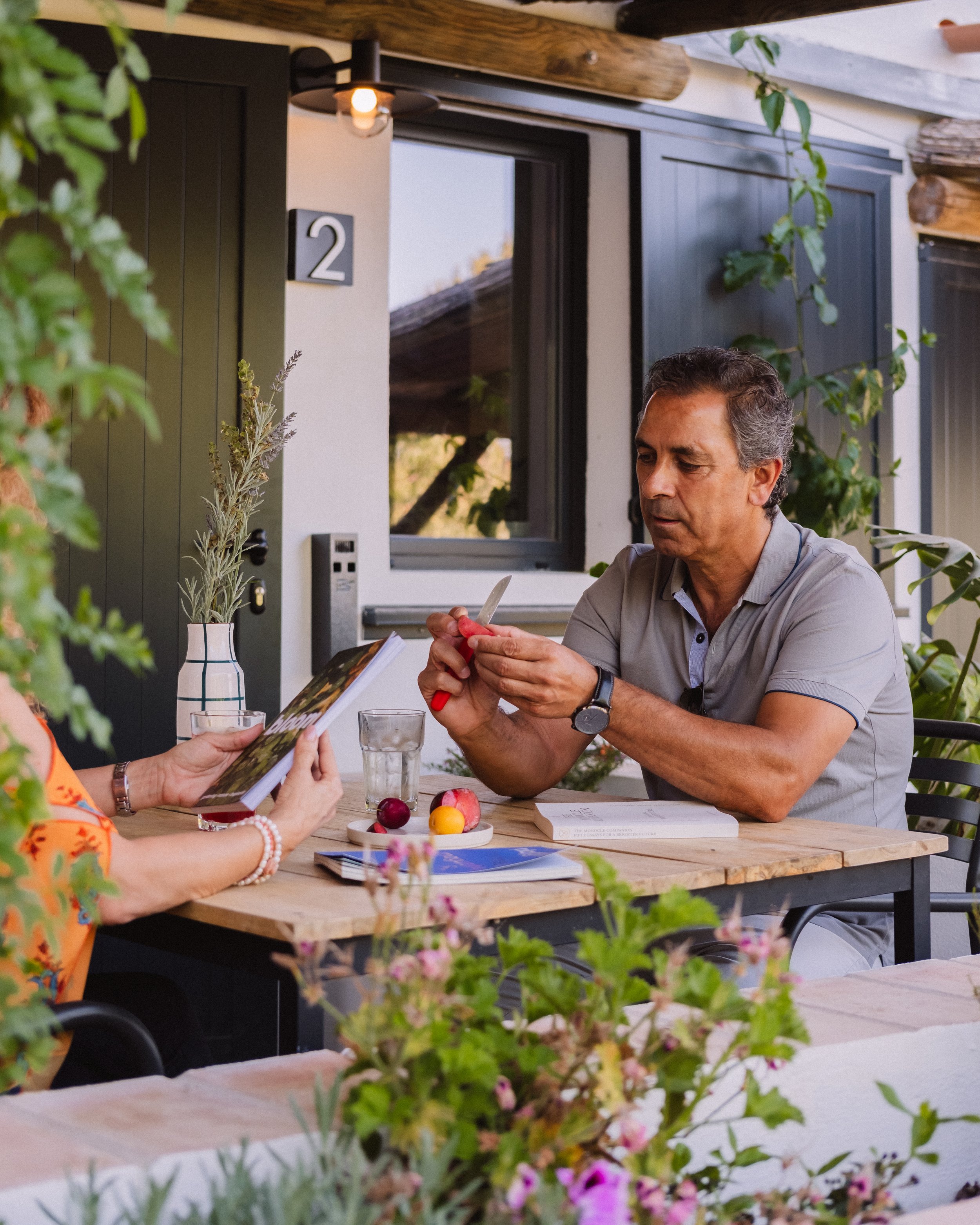
There are hotels with many labels. There are hotels with few. And there are hotels that prefer to explain what they do before sticking a label on the door. Gandum belongs to the latter group.
Not because of mistrust of the labels themselves, but because real sustainability rarely fits well on a sticker. It is made up of continuous decisions, many of them invisible, almost all of them difficult to communicate in a simple way.
Labels are reassuring. Decisions are complicated.
Labels exist to simplify things. They provide security to those who choose and help compare projects that are very different from each other.
The problem begins when sustainability becomes a list of criteria to be met, rather than a coherent system of decisions. When the goal becomes obtaining the seal, rather than understanding whether the choices make sense in that place, in that climate, on that scale.
At Gandum, there was never an initial checklist to follow. There were successive questions: Does this make sense here? Will this stand the test of time? Does this really improve the way the place works?
The answers were not always obvious. Often they meant giving up easy solutions.
Sustainability is not a final layer
Much of the sustainable discourse appears at the end of the process: after the work, after the concept, after the business model. A "green" layer is applied to something that has already been decided. At Gandum, the opposite happened.
Sustainability came before architecture, before the kitchen, before operations. It came when the decision was made to build with structural rammed earth, to accept long timelines, to work with the real limitations of the territory, and to think about durability rather than immediate impact. When decisions are structural, labels become secondary.
What doesn't fit on a stamp
There are many things that are difficult to fit into a certification system:
build one of the largest contemporary buildings in structural rammed earth in the world
planting 50,000 trees knowing that the real impact can only be measured in decades
accept menus that change because suppliers are not industrial
choose materials that are more difficult to clean and maintain
invest in above-average working conditions in a historically precarious sector
None of this is easily quantifiable on a form. But all of this defines the project.
Transparency instead of perfection
One of the pitfalls of labels is the illusion of perfection. The idea that a certified project has "solved" sustainability. At Gandum, the approach was different: to embrace imperfections, limitations, and contradictions. Not everything is local. Not everything is regenerative. Not everything is the best possible scenario.
But everything is thought out, discussed, and reviewed. Real sustainability does not live on absolute promises. It lives on continuous improvement and responsibility assumed over time.
Sustainability as a culture, not as marketing
When sustainability is treated as marketing, it needs to be visible, repeatable, and easily explainable. When it is treated as culture, it permeates everything—even when no one is looking.
In Gandum, she appears:
in the way it is constructed
in the way it is cooked
in the way one works
in the way it is received
Not as a primary selling point, but as a natural consequence of a design built to last.
Choosing not to label is also a choice
Not rejecting labels does not mean rejecting responsibility. It means accepting that the work is more complex than a seal can represent. Gandum will continue to evolve, to measure better, to adjust decisions, and eventually to engage in dialogue with certification systems—but never at the expense of the project's internal consistency.
Because, in the end, the question is not: "Are we sustainable?"
It is another, much more demanding question: "Will this still make sense in 10, 20, or 30 years?"
Sustainability without a stage
Perhaps real sustainability is this: doing the work even when there is no stage, prize, or label. Building slowly. Deciding carefully. Accepting consequences.
At Gandum, this choice was made from the outset. And it continues to be made every day.